Seeed Studio XIAO ESP32-C6 Explained
A complete beginner-friendly overview of the XIAO ESP32-C6 — including its specifications, pinout, onboard features, GPIO, ADC, I2C, SPI, UART, power pins, wireless connectivity and comparison with Arduino UNO.
What is XIAO ESP32-C6?
The Seeed Studio XIAO ESP32-C6 is a compact development board from Seeed Studio's XIAO family.
Its main controller is the ESP32-C6, which is based on the RISC-V architecture.
Despite its very small size of approximately 21 × 17.8 mm, the board provides GPIO, ADC and multiple communication interfaces along with built-in wireless connectivity.
It is a tiny development board that combines processing, GPIO, communication interfaces and wireless connectivity in one compact board.
Arduino UNO vs XIAO ESP32-C6
| Feature | Arduino UNO | XIAO ESP32-C6 |
|---|---|---|
| Microcontroller | ATmega328P | ESP32-C6 |
| Architecture | AVR | RISC-V |
| Board Size | Larger development board | Approximately 21 × 17.8 mm |
| Wi-Fi | Not built-in | 2.4 GHz Wi-Fi 6 |
| Bluetooth | Not built-in | Bluetooth Low Energy |
| Wireless IoT | Typically requires additional hardware | Wireless connectivity integrated |
For basic electronics projects such as LEDs, buttons and simple sensors, Arduino UNO is widely used.
When a project needs a compact board together with wireless connectivity, the XIAO ESP32-C6 provides Wi-Fi 6 and Bluetooth Low Energy directly on the board.
XIAO ESP32-C6 Specifications
Here are the key specifications of the XIAO ESP32-C6:
| Specification | XIAO ESP32-C6 |
|---|---|
| Processor | Espressif ESP32-C6 SoC with two 32-bit RISC-V processors |
| High-Performance Core | Up to 160 MHz |
| Low-Power Core | Up to 20 MHz |
| Wireless | 2.4 GHz Wi-Fi 6, Bluetooth 5.0 BLE & Mesh, Zigbee, Thread and IEEE 802.15.4 |
| On-Chip Memory | 512 KB SRAM + 4 MB Flash |
| GPIO | 11 main GPIO pins |
| ADC | 7 ADC-capable channels |
| Communication Interfaces | UART, LP_UART, I2C, LP_I2C, SPI and SDIO |
| Dimensions | 21 × 17.8 mm |
| Power Input | USB Type-C 5V / Battery 4.2V |
| Operating Voltage | USB: 5V @ 9mA / BAT: 3.8V @ 9mA |
| Battery Charging Current | 100 mA |
| Power Consumption | Modem-sleep: ~30 mA, Light-sleep: ~2.5 mA, Deep-sleep: ~15 μA |
| Operating Temperature | -40°C to 85°C |
Important Parts of the Board
Even though the XIAO ESP32-C6 is very small, several important features are integrated directly onto the board.
USB Type-C Connector
Used to connect the board to a computer, upload programs and provide power.
ESP32-C6 Module
The main processing section of the board. It executes the program and controls the peripherals.
Onboard Antenna
Provides wireless connectivity for the Wi-Fi and Bluetooth features.
User LED
An onboard LED that can be controlled through a program.
Reset Button
Used to restart the development board.
Boot Button
Useful for programming and boot-mode operations.
U.FL Antenna Connector
Provides an option to connect an external antenna.
Castellated Pads
Allow the XIAO to be soldered directly onto a custom PCB.
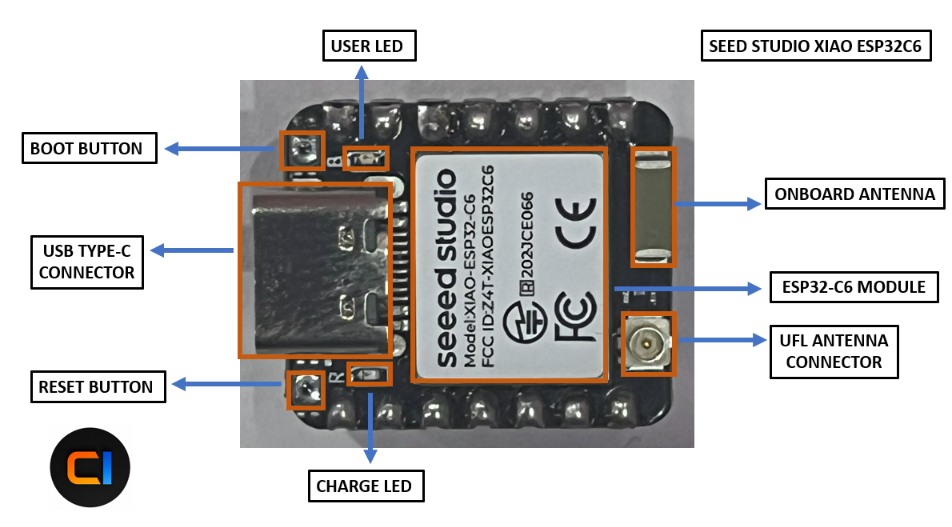
Important onboard features of XIAO ESP32-C6
GPIO Pins
GPIO stands for General Purpose Input Output.
A GPIO can be configured as an input to read a button or sensor signal, or as an output to control an LED, buzzer or another digital control signal.
The main exposed GPIO pins of the XIAO ESP32-C6 are labelled D0 to D10.
| XIAO Pin | ESP32-C6 GPIO | Common Function |
|---|---|---|
| D0 | GPIO0 | Digital / ADC |
| D1 | GPIO1 | Digital / ADC |
| D2 | GPIO2 | Digital / ADC |
| D3 | GPIO21 | Digital GPIO |
| D4 | GPIO22 | I2C SDA |
| D5 | GPIO23 | I2C SCL |
| D6 | GPIO16 | UART TX |
| D7 | GPIO17 | UART RX |
| D8 | GPIO19 | SPI SCK |
| D9 | GPIO20 | SPI MISO |
| D10 | GPIO18 | SPI MOSI |
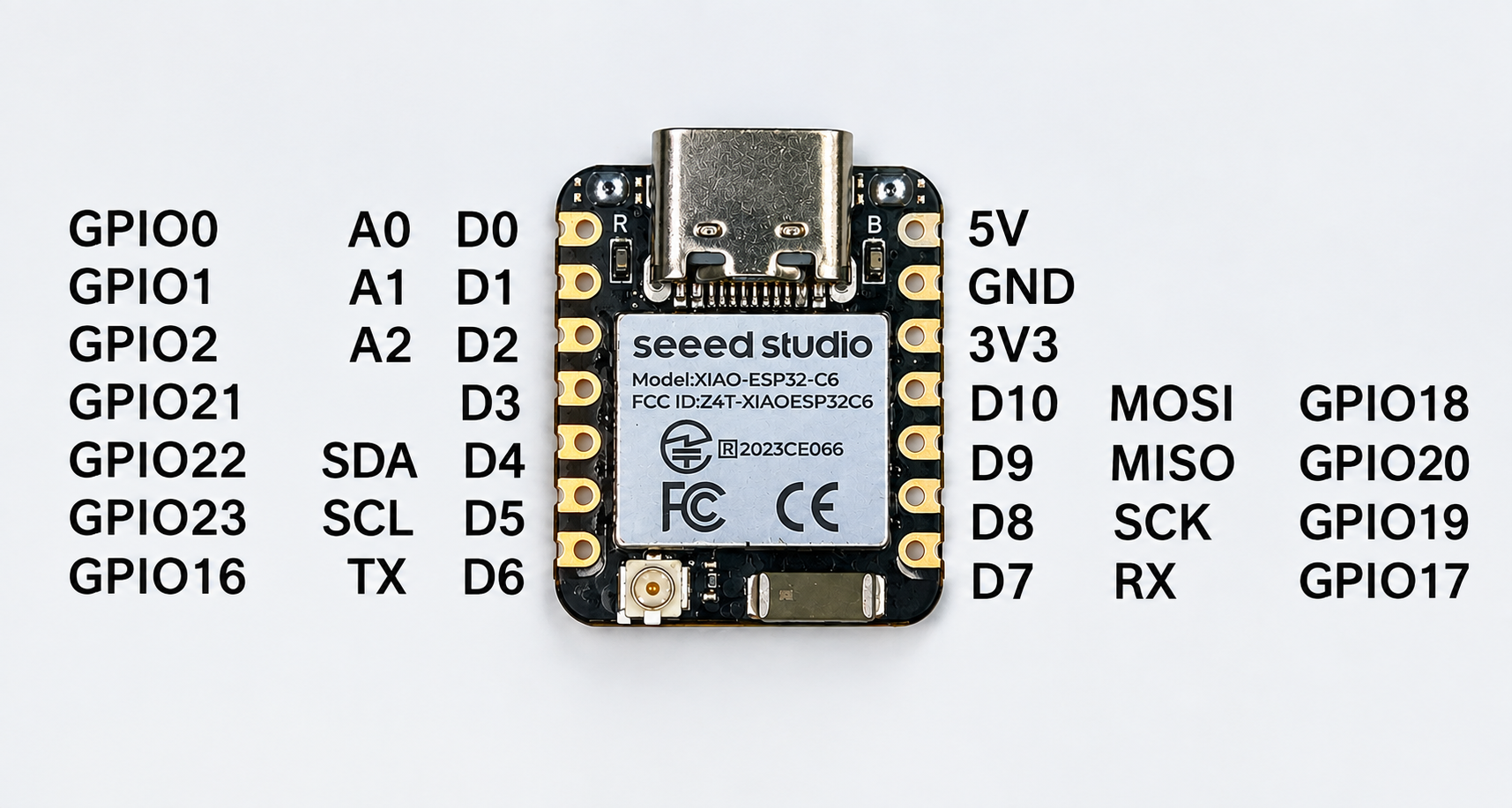
XIAO ESP32-C6 pinout and GPIO mapping
The D-number printed on the board and the actual ESP32-C6 GPIO number are not always the same. This is important to remember while programming.
Analog / ADC Pins
ADC stands for Analog-to-Digital Converter.
An ADC allows the microcontroller to measure an analog voltage and convert that voltage into a digital value that can be processed by software.
| Pin | GPIO | Function |
|---|---|---|
| D0 | GPIO0 | ADC |
| D1 | GPIO1 | ADC |
| D2 | GPIO2 | ADC |
For example, a potentiometer can produce a continuously changing voltage. The ADC can read this changing voltage and convert it into a digital value.
Additional ADC-capable GPIOs are also available on the back side, including GPIO4, GPIO5 and GPIO6.
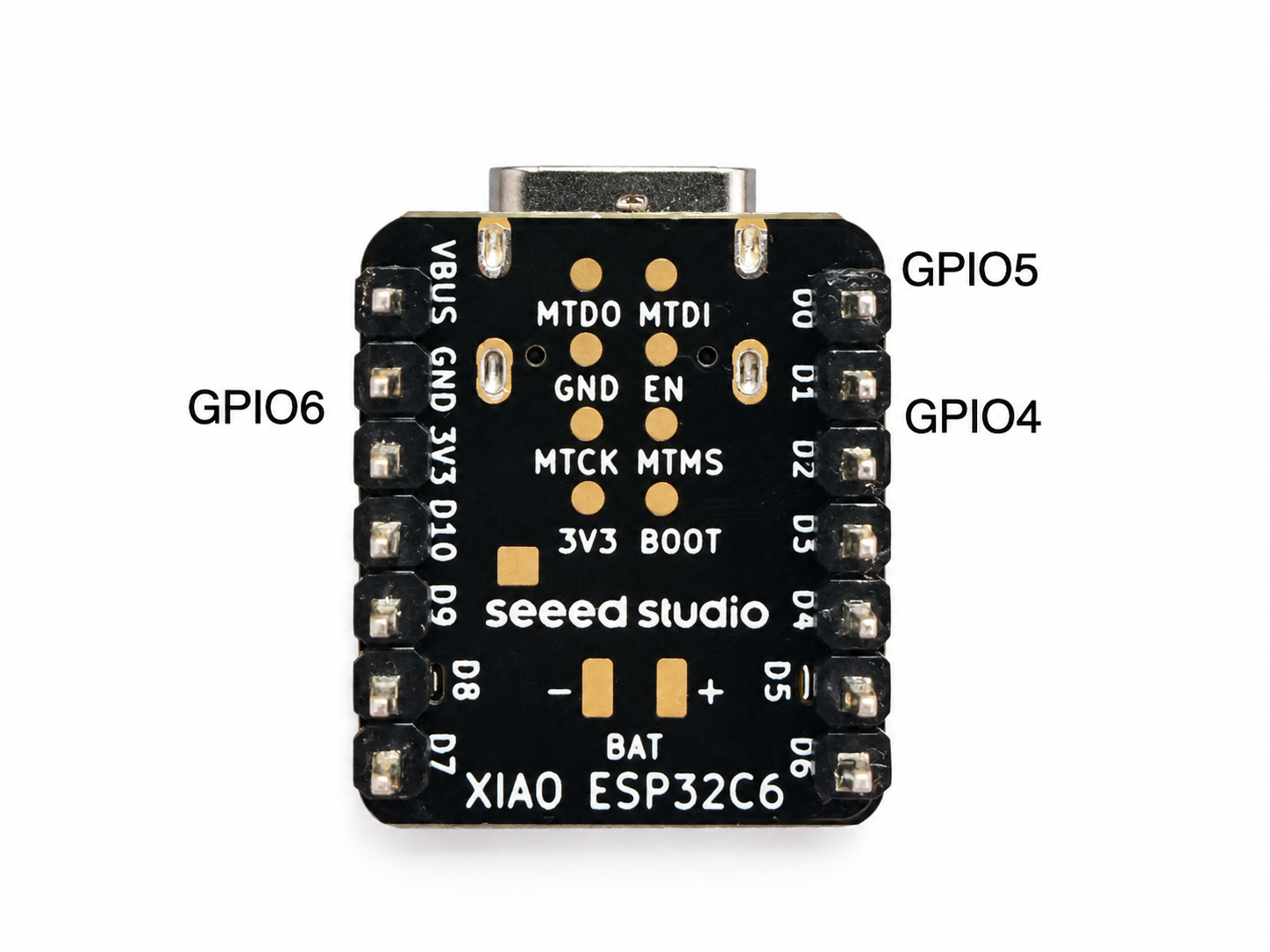
Backside connections and additional GPIOs
I2C Communication
I2C is a communication protocol that uses two main communication lines.
| XIAO Pin | GPIO | I2C Function |
|---|---|---|
| D4 | GPIO22 | SDA |
| D5 | GPIO23 | SCL |
For example, the MPU6050 sensor can communicate with the XIAO using I2C.
A 16×2 LCD with an I2C module can also be connected to the same SDA and SCL communication lines.
This makes I2C useful when multiple compatible devices need to communicate with the microcontroller using relatively few wires.
SPI Communication
SPI is another communication interface that can be used to connect the XIAO ESP32-C6 with external devices.
| XIAO Pin | GPIO | SPI Function |
|---|---|---|
| D8 | GPIO19 | SCK |
| D9 | GPIO20 | MISO |
| D10 | GPIO18 | MOSI |
One example of an SPI device is the NRF24L01 wireless module.
A suitable GPIO can be used for CS/CE depending on the application and wiring configuration.
UART Communication
UART is commonly used for serial communication between the XIAO and external devices.
| XIAO Pin | GPIO | UART Function |
|---|---|---|
| D6 | GPIO16 | TX |
| D7 | GPIO17 | RX |
A common example is the NEO-6M GPS module.
GPS TX → XIAO RX
GPS RX → XIAO TX
The GPS module can send serial positioning information to the XIAO, which can then process information such as latitude, longitude and time.
Power Pins
| Pin | Purpose |
|---|---|
| 5V | USB VBUS related power connection |
| GND | Common ground connection |
| 3V3 | Regulated 3.3V output |
The 3V3 pin can be useful for compatible 3.3V sensors and modules.
Do not connect 5V, 3V3 and GPIO pins interchangeably. Always check the operating voltage requirements of the sensor or module before connecting it.
Wireless Connectivity
2.4 GHz Wi-Fi 6
The XIAO ESP32-C6 can connect to a Wi-Fi network and exchange data with servers, applications and other network devices.
Bluetooth Low Energy
BLE provides low-power wireless communication and can be used to communicate with devices such as smartphones.
Zigbee
The ESP32-C6 platform also supports Zigbee-based wireless applications.
Thread
Thread support makes the platform suitable for certain low-power connected-device applications.
How to Program XIAO ESP32-C6
The XIAO ESP32-C6 can be programmed using the Arduino IDE.
| Step | Action |
|---|---|
| 1 | Install the required ESP32-C6 board support. |
| 2 | Connect XIAO ESP32-C6 to your computer using USB Type-C. |
| 3 | Select the correct XIAO ESP32-C6 board. |
| 4 | Select the correct COM port. |
| 5 | Upload your program. |
If you have already programmed an Arduino UNO, the basic Arduino IDE workflow will feel familiar.
Applications
IoT Projects
Connected sensors and smart monitoring systems.
Wireless Devices
Wi-Fi and Bluetooth-based electronics projects.
Robotics
Compact controllers for sensors, motors and wireless communication.
Mobile Connectivity
BLE communication between the board and smartphones.
Compact Products
Useful when PCB space is limited.
Connected Sensors
Sensor data can be processed and transmitted wirelessly.
XIAO ESP32-C6 at a Glance
Final Conclusion
The XIAO ESP32-C6 is a compact development board based on the ESP32-C6 microcontroller and RISC-V architecture.
We looked at its specifications, onboard features, GPIO and ADC capabilities, I2C, SPI and UART interfaces, power pins and wireless connectivity.
Compared with a traditional Arduino UNO, one of the major differences is the combination of a very compact form factor with integrated wireless connectivity.
Size chhota hai, lekin possibilities kaafi badi hain. 🚀